Würzburg spinout NanoStruct raises €2.6M for AI-powered food pathogen sensors
Under Regulation (EC) No 2073/2005, food manufacturers are legally required to test for Listeria monocytogenes and Salmonella at every stage of production. Standard culture-based methods take two to three days to produce a result. According to the EFSA and ECDC One Health Zoonoses Report (December 2025), in 2024 the EU recorded 6,558 foodborne outbreaks, up 14.5% on the prior year, with Listeria causing the highest proportion of hospitalisations. The compliance testing bottleneck is at the heart of the problem. Batches that would fail to produce a result on the same day can spend two to three days in distribution before a laboratory confirms contamination.
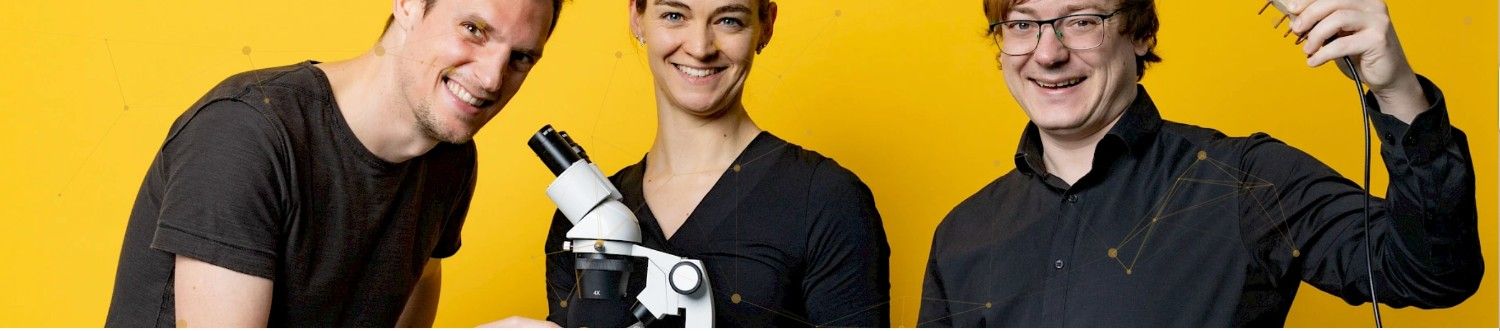
NanoStruct, a company founded in 2021 by Dr Henriette Maaß (Co-Founder and CEO), Enno Schatz (Co-Founder) and Kai Leibfried (Co-Founder) as a spin-off of Julius-Maximilians-Universität Würzburg, has developed nanostructured optical sensor chips that reduce the detection time to a few hours. The chip captures bacterial signatures via optical readout, and a machine learning classifier identifies the pathogen from the resulting spectral fingerprint. The system is intended for use in food industry quality laboratories as a tool for achieving same-day compliance with regard to Listeria and Salmonella, replacing culture-based methods without requiring upgrades to laboratory infrastructure.
The company has raised €2.6 million in a seed round co-led by High-Tech Gründerfonds (HTGF), Bayern Kapital and AUXXO Female Catalyst Fund. This builds on earlier grants from the German Federal Ministry for Economic Affairs and Energy and the European Union. The capital will fund pilot validation with food industry partners and team growth.
Although Regulation (EC) No 2073/2005 requires compliance, it does not stipulate a maximum detection time. This leaves the two-to-three-day culture window as an unchallenged industry standard. NanoStruct's sensor-chip approach addresses the surveillance gap identified by the EFSA and ECDC: the time lag between contamination occurring and a laboratory confirming it.
Sources: NanoStruct | EFSA/ECDC One Health 2024 Zoonoses Report | Crunchbase
Founders: Henriette Maaß, Enno Schatz, Kai Leibfried